)
) Research (Selected)
KIT-OF-PARTS BUILDING SYSTEMS: This research seeks to derive shape grammars and design principles for the development of component-based (kit-of-parts) building systems and space generation rules. Building systems include 1) linear geometry joint-based assemblies, where a standard joint is utilized for all connections, 2) planar geometry panel-based assemblies, 3) solid geometry modular assemblies, and 4) time geometry deployable assemblies. Other concepts under study include plug-in assembly or disassembly by hand without tools, integration of power & communication systems into structure, and plug-in sensors and actuators.
Gnosis Kit-of-parts / Partyhut
VIRTUAL BUILDINGS (or architectural information visualization): This research is to address the electronic representation of buildings in the computer. The virtual or digital building would begin in the conceptual design stage and become fully developed in the design process. Containing all attributes of a real building, the virtual building can be analyzed, walked-through, and viewed in various ways: from plans and sections to structure to textual description. This research also touches on Remote Facility Management, involving the use of a virtual building as a tool for facility management. Connecting the virtual building with the real one via sensors and controllers, the building can be monitored and managed from remote locations via telephone, Internet, and wireless.
IF7 IT Condo Remote Facility Management
Diginoid Digital Manufacturing
AUTOMATED CONSTRUCTION: This research seeks to derive design principles for kit-of-parts building systems developed in parallel with robotic construction systems. Using shape grammars, snap-together joints, and pre-manufactured components, automated construction techniques can be applied task by task without the complicated fabrication techniques involved with raw materials. The eventual scenario dictates that the virtual or digital building model will know how to output its own real-world counterpart through information infrastructures and automated manufacturing systems much the same way a word processing document becomes hard copy in a printer.
AMURAD Robotic Construction System
LDS Robotic Construction System
SPACE ARCHITECTURE: This research takes the next logical step for automated robotic construction systems and processes, and applies the technology to extreme environments where maintaining a construction labor force is costly and dangerous, including high altitude, desert, marine, underwater, polar, space orbital, and space planetary surface. Construction systems for harsh environments must accommodate novel applications for compactness, deployability, self-assembly, mobility, and transportability, while withstanding the rigors of extreme temperature differences, pressure differences, microgravity, reduced gravity, cosmic radiation, micrometeoroids, free molecular oxygen decay, fine dust, and harsh insolation.
MOBITAT Mobile Modular Habitat
Cubolding Self-assembling Structures
TRIGON Self-assembling Structures
DIGITAL HISTORIC PRESERVATION: This research seeks to preserve quality historic structures through digital archival. Historic structures are measured and reconstructed in a solid modeling computer program, whereupon virtual structures and neighborhoods can be posted online for remote navigation and education.
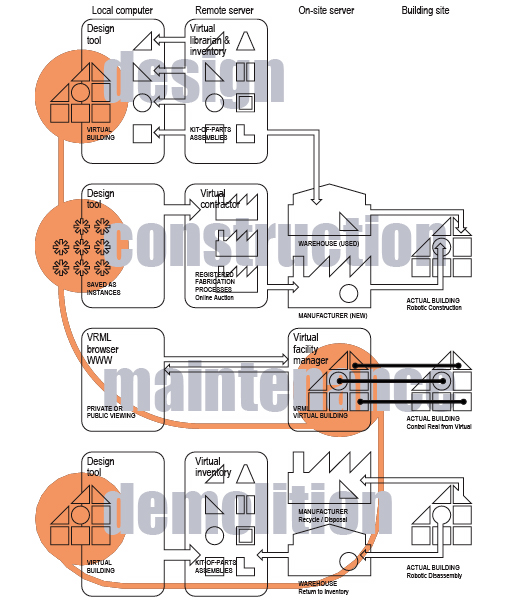
The various research tracks support an entirely digital paradigm for the construction industry, as described in the following diagram (click here for a printable PDF document):