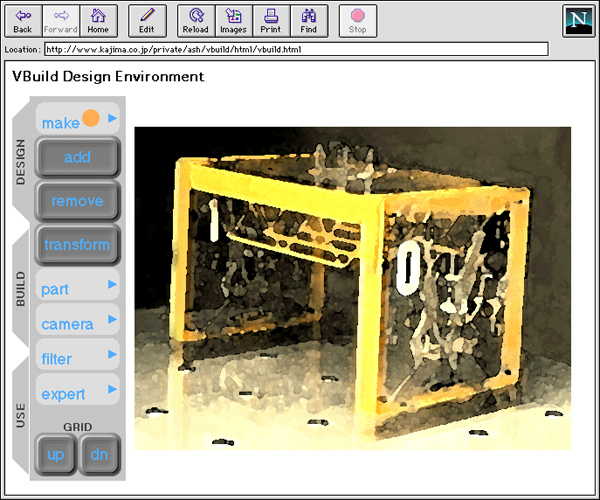
VBuild Design Tool
INVESTIGATORS: A. Scott Howe (PI). Advisors: James Turner, Harold Borkin, Michael Parsons, Lynn Conway.
FUNDING: Supported by Kajima Corporation, Tokyo, Japan as part of doctoral research.
PERIOD: Sep 1995 - fall 1998.
ABSTRACT: This research describes an experimental browser / modeler which will allow a user to collect and assemble virtual kit-of-parts components from "component libraries" located on the Internet (such as manufacturer’s databases) and assemble them into a virtual representation of a building. The fully assembled virtual building will provide a basis for ordering and manufacturing actual components and preparing for construction. The proposed browser will allow the designer to affect a limited degree of remote fabrication at real manufacturing facilities, and facilitate eventual interface with built in sensors and actuators. The browser will manipulate and display interactive three-dimensional objects using Virtual Reality Modeling Language (VRML). Upon assembly, actual components will have sensors built into them to provide data about the real building, which could be viewed during a walkthru of the virtual building by clicking on parts of the model. The virtual building will work as a remote facility management tool for monitoring or controlling various architectural devices attached to the real building (such as electrically driven louvers, HVAC systems, appliances, etc.) The browser (hereafter called VBuild) makes maximum use of the two powerful concepts of object-oriented programming and the kit-of-parts philosophy.
VBuild was initially coded in C++, and then migrated over to Java programming language. VBuild was an initial attempt to demonstrate the feasibility of the digital construction paradigm. Using VBuild, a designer can connect to kit-of-parts libraries on the Internet, representing high-level building blocks based on standard interfaces, and insert instances into a local model. The library original is maintained by the manufacturer, allowing simple sum totals of instances for cost estimating, initiating manufacturing runs, and arranging transport.
VBuild linked several implemented functions that demonstrated feasibility of the digital paradigm:
- Real-time download of library elements from the Internet to populate an interactive model.VBuild implemented a series of object-oriented classes that compiled into a network-based modeler.
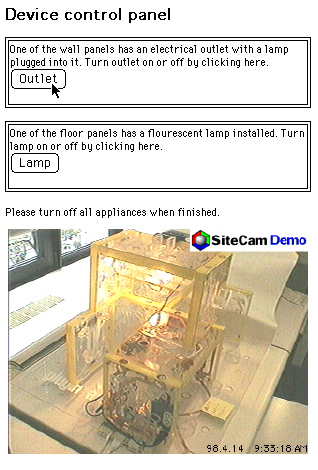
- Connection to a real remote control kit-of-parts system (see REMOTE CONTROL KIT-OF-PARTS) for the purpose of turning lights and other appliences on or off.
- Remote monitoring using webcams.
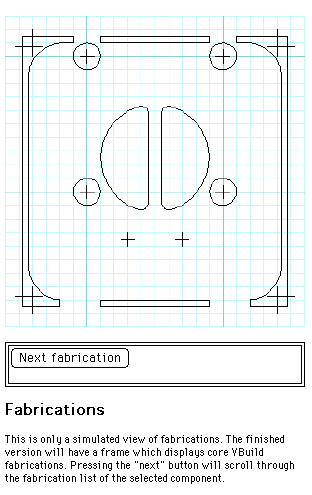
- Digital fabrication of individual parts (see VFAB DIGITAL FABRICATION). Parts were actually manufactured separately using NC equipment, but the manufacture process was only simulated in VBuild.
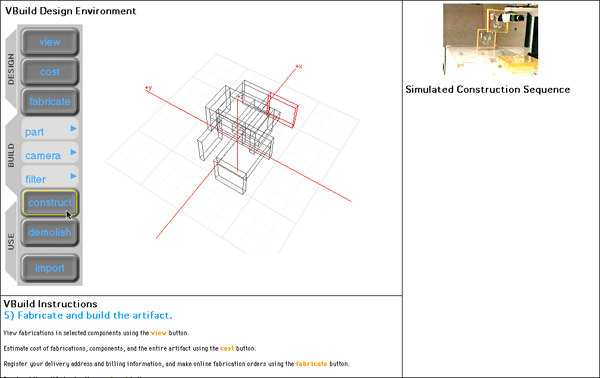
- Fully remote robotic assembly of parts using an industrial robot (see REMOTE CONTROL KIT-OF-PARTS). The robotic assembly and disassembly was completed separately, where only videos of the sequence were shown in VBuild to simulate the processes.
Other relevant links, images, and animations:
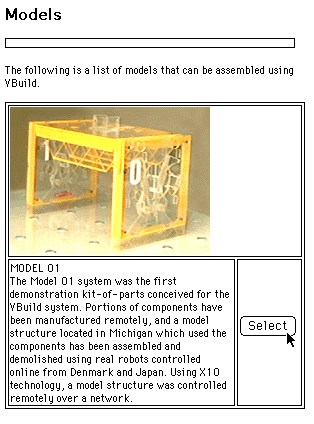
The first network-based kit-of-parts building system implementation
White paper describing VBuild and the Java classes (PDF)
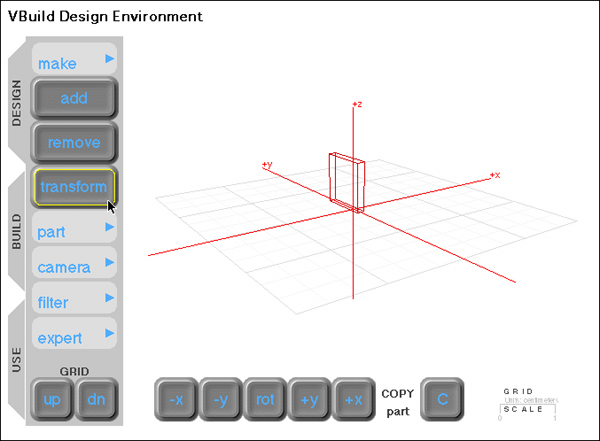
Kit-of-parts system dialog
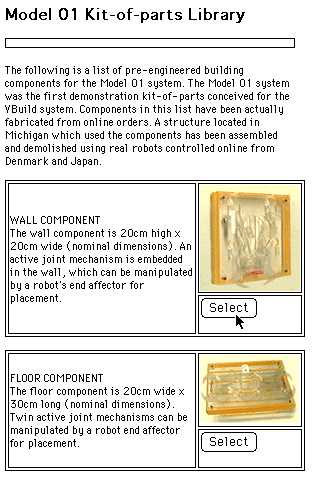
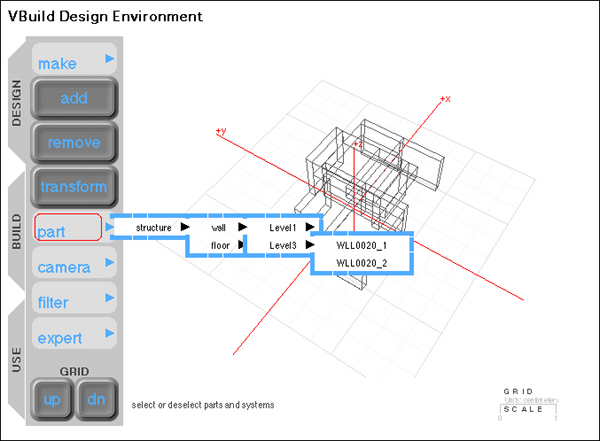
Virtual library dialog
Robotic assembly VBuild screen shot (simulated)
Remote control dialog
Fabrication viewer dialog (simulated)
A.S. Howe (1998). A new paradigm for life-cycle management of kit-of-parts building systems. (Doctoral Dissertation, University of Michigan, 1998). University Microfilms International, No. 9909905.
A.S. Howe (1997). A Network-based Kit-of-parts Virtual Building System. Proceedings of CAAD Futures ‘97. 4-6 August 1997, Munich, Germany, pp. 691-706. Boston: Kluwer.
A.S. Howe (1997). Internet-based Remote Facility Management. Cities for the 21st Century. Proceedings of the Third International Convention on Urban Planning, Housing & Design (ICUPHD'97), pp.197-204. Singapore: Centre for Advanced Studies in Architecture, National University of Singapore.
A.S. Howe (1997). Network wo Base to shita Buhinka Virtual Kenchiku System (A Network-based Kit-of-parts Virtual Building System). Dai 20 Kai Joho System / Riyo / Gijutsu Symposium Ronbunshu (Proceedings of the 20th Symposium on Information Systems, Utilization, and Technology), pp.283-288. Tokyo, Japan: Nihon Kenchiku Gakkai Joho System Gijutsu Iinkai (Architectural Institute of Japan Research Committee on Information Systems Technology).
A.S. Howe (1996). Internet-based Architectural Visualization. Constructions of Tectonic for the Postindustrial World. Proceedings of the 1996 ACSA European Conference, pp.245-250. Washington, DC, USA: Association of Collegiate Schools of Architecture.