IF7 IT Condominium
INVESTIGATORS: A. Scott Howe (Co-I), working as Plug-in Creations Architecture, LLC contractor for IMS team member Kajima Technical Research Institute (KATRI).
FUNDING: US$9,000 (Dr. Howe's portion) funded through Kajima Technical Research Institute (KATRI).
PERIOD: Apr 2001 - Mar 2002.
ABSTRACT:
Overall IF7 project abstract:
The aim of this research is to develop technologies for automated assembly of large structures such as factory facilities. The project aims at turning the following seven dreams into reality:
- If we could build large scale objects, e.g., building, bridge and ship, in a comfortable condition somewhat like an air-conditioned factory, ...
- If we could easily build a temporary factory at site, ...
- If we could decrease construction duration half as short as that of today, ...
- If robots could assemble large components easily, ...
- If detailed information, proactive advises and guidelines in all locations of construction sites could be accessible by people for thinking or decision-making, ...
- If we could have virtual dynamic construction simulation system integrated with an intelligent planning, scheduling and performance management system, ...
- If autonomous agents could support our decision making, ...
This project will attempt to develop the technology and machinery required for automatic assembling of large structures such as buildings and ships.
The advantages and limitations of two basic alternative assembly methods will be established: assembly of unit members such as columns and beams singly into the end structure, versus assembly of components first into blocks of appropriate size before incorporation into the final structure.
To automate component assembly, novel concepts will be applied to the development of new types of industrial robots capable of handling large, heavy members or blocks to establish the mechanics of their operation and ensure their working accuracy.
Work will also be done to develop an information management system with decision-making ability to solve problems arising at any stage of assembly, using a comprehensive database containing knowledge accumulated from experience as well as all relevant information input, from the design stage to daily variables at the building site.
A sub-system will be developed to provide timely information on potential hazards at a site and other factors that might interfere with productivity, and to identify counter measures.
Sub-abstract (managed by Dr. Howe):
This research will develop a robotic construction system based on the IF7 goals and concepts, for the purpose of constructing mid-rise residential condominiums. The condominium will be organized in a kit-of-parts approach with standard generic infill block modules that can be inserted into infrastructure superstructure frames using incorporated automated winches, cranes, and other robotic hardware in a holistic approach to automated construction.
Other relevant links, images, and animations:
White paper discussing the IF7 kit-of-parts concept (PDF)
Webpage discussing IF7 kit-of-parts concept (html, Flash, VRML)
IF7 construction sequence animation (2.7mb)
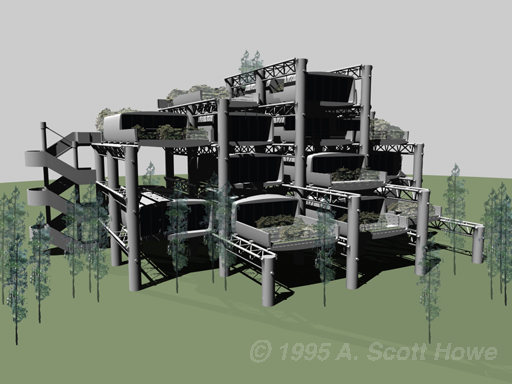
A.S. Howe; I. Ishii; T. Yoshida (1999). Kit-of-parts: A review of object-oriented construction techniques. Proceedings of the International Symposium on Automation and Robotics in Construction (ISARC16). 22-24 September 1999, Madrid, Spain. London: International Association for Automation and Robotics in Construction (IAARC).
Miyamoto, Ishii, Shibata, Dobashi, Howe, Yoshida, Takada, Ueno, Kunugi, Yagi, Nakata, Hatakeyama, Kigawada, Yomo, and Koga (1998). Study on assembly process for large-scale structures. Heisei 10 nendo IMS Kenkyu Seika Koen Ronbushu (1998 IMS Research Results), pp.119-122. Tokyo, Japan: Intelligent Manufacturing Systems (IMS) Center.