Object-oriented Construction
INVESTIGATORS: A. Scott Howe (PI).
FUNDING: Hong Kong University Initiation Grant HKD120,000 (US$15,000).
PERIOD: Jan 2002 - June 2003.
ABSTRACT: This research will demonstrate that well designed shapes, configurations and groupings of building components can contribute to the sustainability of buildings.The use of Kit-of-parts construction is significant in that various parts of a structure and associated systems can be planned for replacement, demountability, and recycle, without disrupting the integrity of the overall structure or investing in expensive retrofit.
Also, the careful selection of materials and construction / manufacturing processes can contribute to the sustainability of buildings. Kit-of-parts construction allows the use of efficient manufacturing practices, such as "assembly line" construction and automation. The majority of current construction can be considered "final line" construction (as opposed to "assembly line" manufacturing), where materials and labor are all brought to the site for cutting, forming and fitting into place. In "final line" construction, processes performed on site are at the mercy of uncontrollable environmental factors, are often unsafe and dangerous, take a lot of time and coordination, and generate much waste and refuse. "Final line" construction also produces fixed, static designs that are often already obsolete at the time of initial occupancy. The greatest amount of waste and impact on the environment occurs when conventional "final line" buildings are demolished and very little of the material is recoverable for recycle or reuse. The overall inefficiency of processes and choice of materials associated with "final line" construction generally run counter to sustainability principles.
In underdeveloped countries, automation appears to be inappropriate due to the abundance of cheap labor. However, labor is another dimension to sustainability, and establishing industries wholly based on the idea of an abundance of cheap labor also runs counter to sustainability principles.
The use of digital manufacturing techniques and automated construction technology using 100% recyclable and renewable materials is significant because of the increase of accuracy and efficiency, and reduction in assembly / erection time and material waste. Kit-of-parts / object-oriented approaches to construction can take advantage of these technologies to contribute to sustainable building practices.
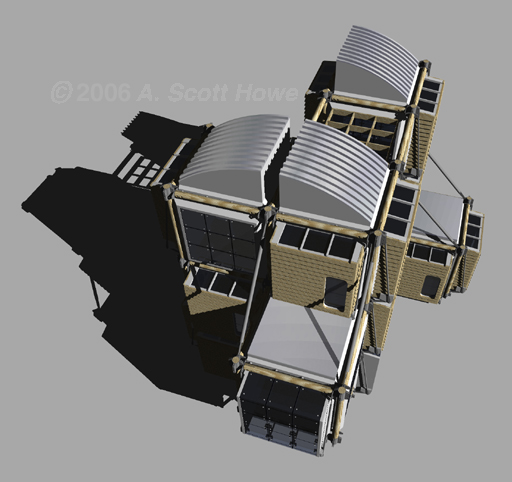
C.M. Herr; A.S. Howe (2006). A high density open building studio project for Hong Kong. Open House International. Vol 31 No 2 pp32-41.
K. Sy; A.S. Howe (2003). Adaptable Unitized Facade for High-rise Office Buildings in Hong Kong. Proceedings of the Second International Conference on Construction in the 21st Century (CITC-II). 10-12 December, 2003, Hong Kong.
M. Ho; A.S. Howe (2003). Visual – Virtual Light Facades in the Information Age. Proceedings of the Second International Conference on Construction in the 21st Century (CITC-II). 10-12 December, 2003, Hong Kong.
A.S. Howe (2003). Design Principles for Kinematic Architecture. Proceedings of the Second International Conference on Construction in the 21st Century (CITC-II). 10-12 December, 2003, Hong Kong.