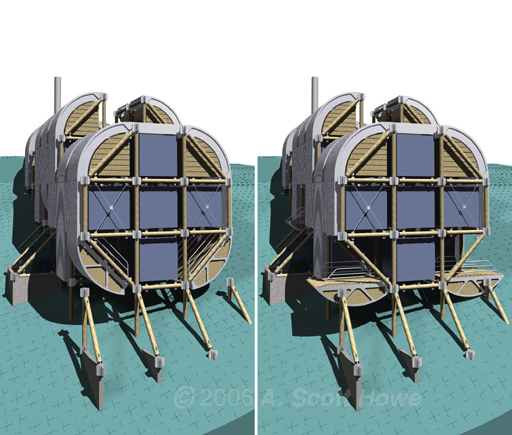
Appletree Residence (2004)
CLIENT: personal residence.
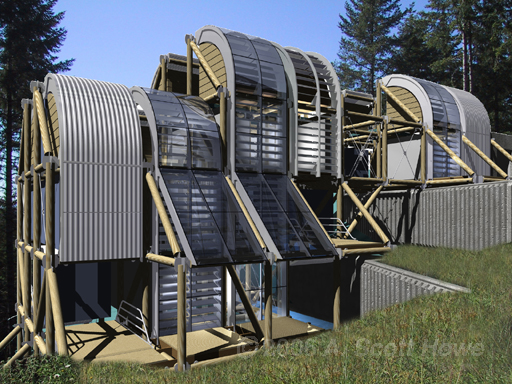
CONCEPT: A post and beam heavy timber support structure with infill kit-of-parts elements. A grid of permanent foundation "plug-in" receptacles for future structure was designed. The structure could be filled out as needed, with columns plugging into the receptacles.
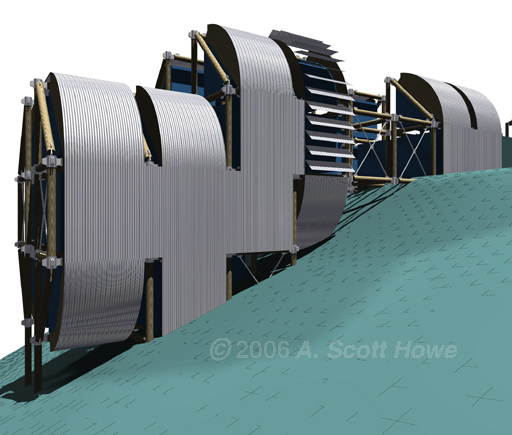
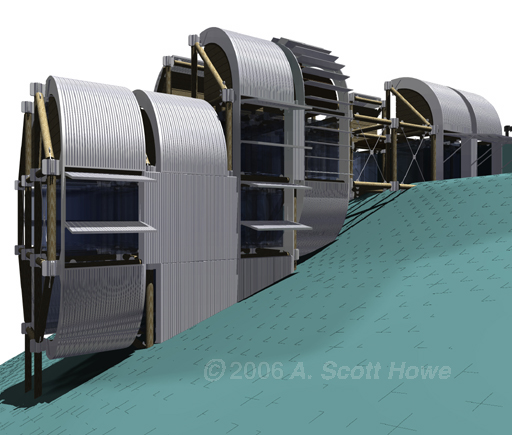
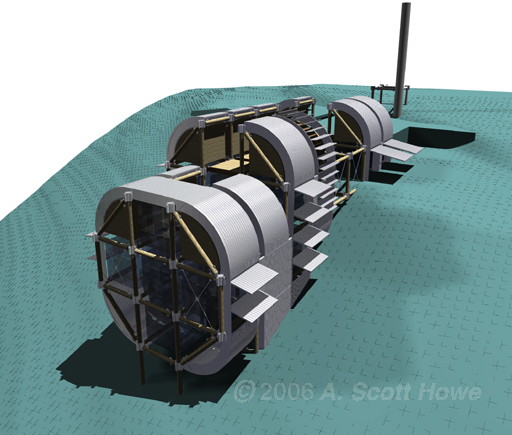
One major innovation in the project was the deployable decks. In closed form the decks completed the continuous curve begun in the roofline, continuing down the wall and tucking itself under the structure to create a floating effect. When deployed, the decks would hinge down and complete a bridge linking the residence interior to exterior permanent decks, in a "drawbridge" effect.
Another major innovation in this project was the way the project was organized. The innovative aspects of the project were the dimensionless plans, sections, and elevations, where kit-of-parts components were labeled and located on a three-dimensional grid. All dimensions occurred on the "component" sheets, consisting of 30 large pre-manufactured assembly infill "alphabet" primitives that were sized to be inserted into the post and beam support structure. Each "component" is completely without context, and can be fully manufactured in a controlled environment, in most cases by fully numerical control (NC)-driven processes. Most of the "component" sheets included NC outlines in graphic form, with a three-dimensional exploded view of the component.
Site-specific design was limited to foundation planning, using conventional retaining wall and pile foundations, and environmental considerations taken into account for building orientation and kit-of-parts component selection for specific locations.
DESIGN TEAM: Architectural design, structure concept, modular systems by A. Scott Howe. Preliminary structure by Craig Gibbons of Ove Arup Engineers (Hong Kong). Final structure calculations by Rene Fabricant and Rick Hernandez (Branch Engineering, Eugene, Oregon).
COST: US$750,000.
DATE: 2004.
STATUS: Project went through complete working drawings (91 sheets) and county planning and building approval process, but was sold before construction.
Other images and animations:
wall panels closed
wall panels open
wall panels open (birdseye view)
abbreviated architectural plans (PDF)
example "component" sheet beam (PDF)
example "component" sheet module (PDF)