Qamel Specialty Vehicle (1996)
.....of the International Audi Design Competition (1997).

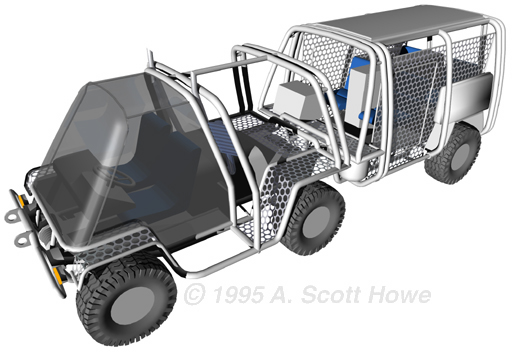
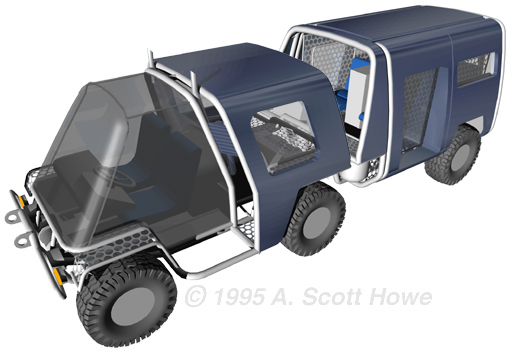
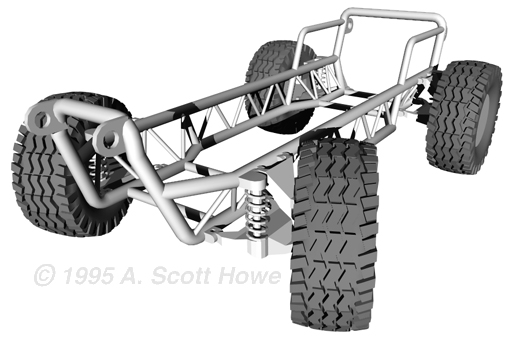
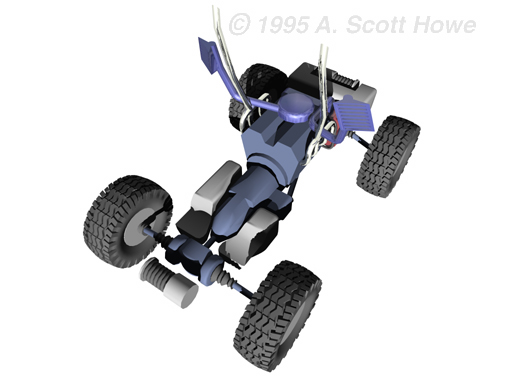
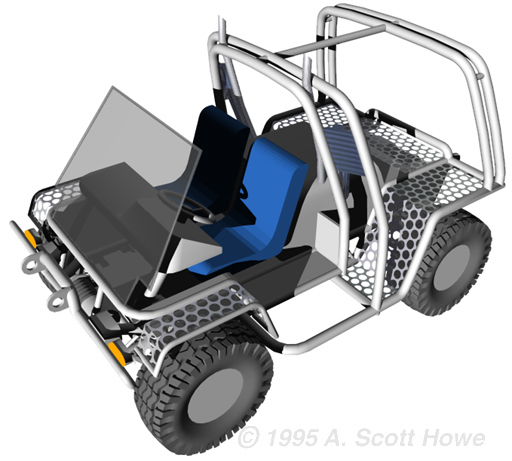
CONCEPT: The vehicle concept was conceived as a modular design consisting of a tractor or power plant and a plug-on special-function module. Using a light frame, the vehicle would act as a "sand rail" or dune-buggy in its most basic form and have a snap-on panel system for adapting its use to various climates. The panel system would include a range of materials from modular canvas to thickly insulated panels: in the above image, the glass cockpit shown would only be one variation of a cab enclosure which is completely demountable. The tractor unit would carry up to four persons with simple demountable seats over the rear wheel wells. The tractor unit would be equipped with both front and rear winches. The wheels are all-wheel drive mechanically driven with front wheel steering and all-wheel independent suspension. The turning radius of the tractor unit is 6 meters.
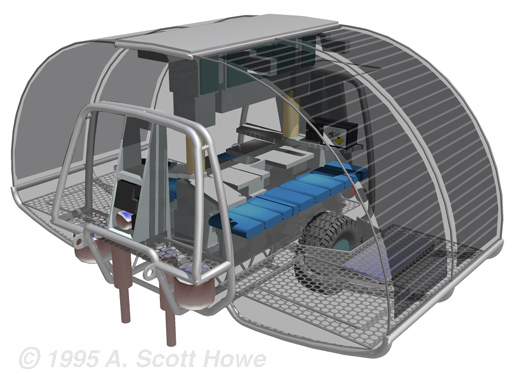
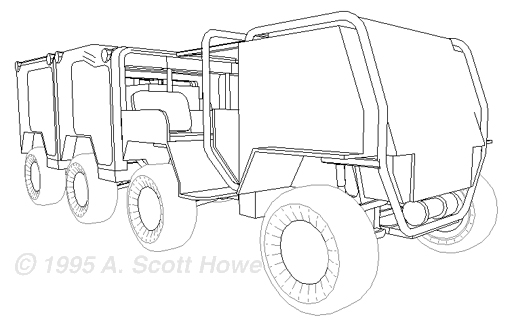
The plug-on rear special-function module would be mountable / demountable from the tractor unit. When connected, the entire vehicle is hinged in the middle with a single degree of freedom in pitch. The rear module wheels are hydraulically steered to allow the entire vehicle to have a 7.5 meter turning radius. During normal operation the rear module wheels spin freely but can be electrically driven for added push in all-wheel drive situations.
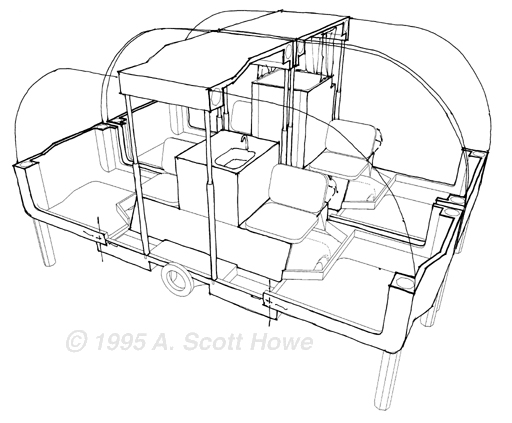
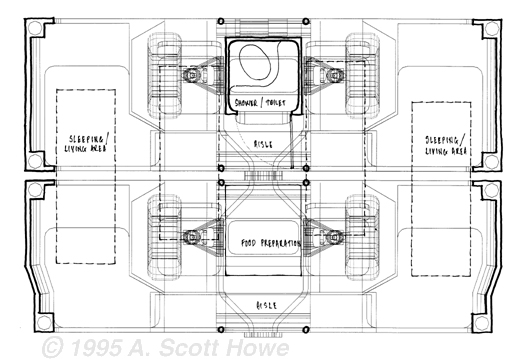
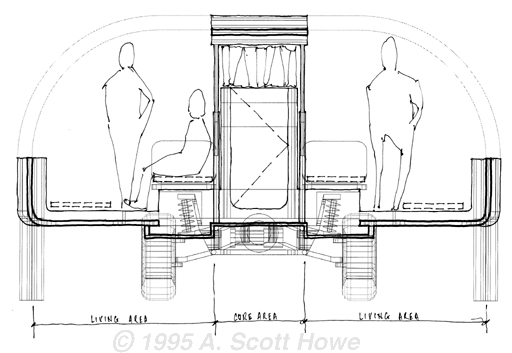
The rear special-function module was conceived as fold-out living space in order to satisfy the design requirements. Nevertheless, plug-on units could be conceived with other functions including field hospital, fire fighter base, communications module, field office, etcetera. In this version, the module seats up to four passengers and can accommodate living space for the same number. Fold-up seats flank a "core" island which contains fold-out table, sink, refrigerator and storage space. The fold-up seats fit together to form a cot or bench seat. Located on the rear of the module is a fold-out shower / toilet enclosure. The side walls consist of expanded metal decking mounted on curved frames which fold down on deployment of the module. Between the decking and the frames water tanks and other euipment are tucked away. When the walls fold down the decking becomes flooring, the roof pops up and canvas curved sidewalls are supported by flexible aluminum tubular supports.
DESIGN TEAM: The design team included multi-disciplinary members. Project team leader: A. Scott Howe, architect. Other design team members: Bob Gelardi, Mark Borus, Darren Wolfberg. Advisors include Colin Clipson, Shawn Jackson, and Tom Gillespie of University of Michigan schools of architecture, art, and mechanical engineering. Other valuable support includes AM General Corporation via the advisorship participation of Hummer Chief Engineer Rick Fanco.
DATE: Summer 1996.
STATUS: Conceptual design and mock-ups.
Other images and animations:
tractor and specialty unit in bare-frame sandrail form
tractor and specialty unit fitted with insulated panels
tractor frame
tractor engine and drive train
animation of the specialty unit deploying itself (1mb)
animation of field residence core deployment (specialty unit) (948kb)
Qamel Specialty Vehicle paper (PDF)