Capsule Hotel (1995)
CLIENT: Japan Railway.
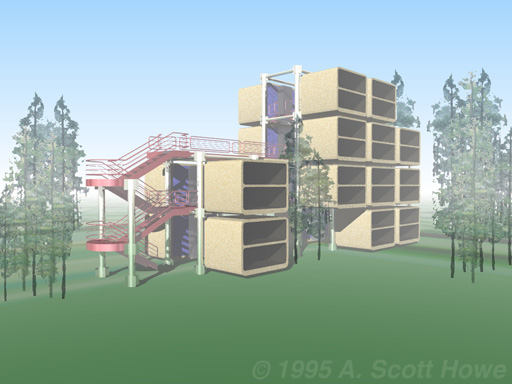
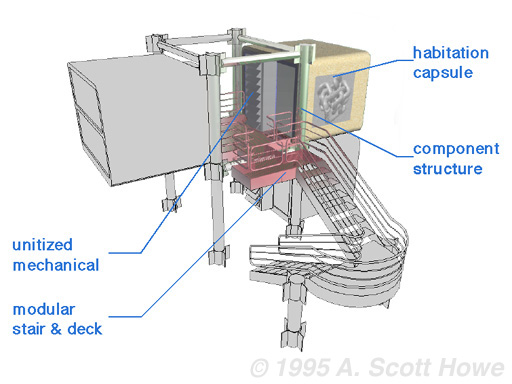
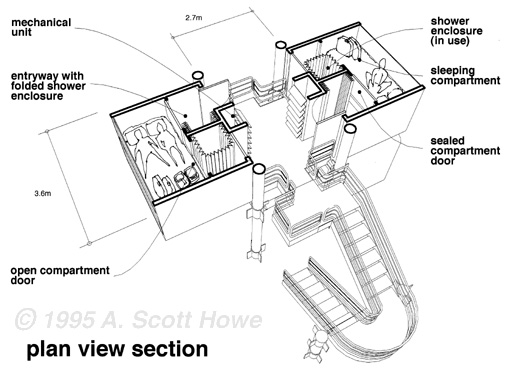
CONCEPT: A library of components that can easily be assembled together is pre-manufactured and constructed into capsule motels at train stations. Capsules can be coin operated similar to lockers, and accessed directly from the platform. Each module is manufactured with a spun fiberglass shell and integrated structure that can be cantilevered from a central structure. Each module has two full-height entrances which access upper and lower sleeping shelves. Only one sleeping shelf is accessible at a time from any one entrance, unless both entrances of the same module are rented and the removable block panel is unlatched from both sides. Each entrance converts to a small shower stall.
Each train station that is projected to maintain a capsule hotel would have a foundation grid constructed which reflects the maximum possible expansion for the hotel. The modular system would be assembled as needed on the foundation grid, leaving unused foundation sockets. When certain train stations show the need for more modules, capsules can be removed from another site, transported by train, and reassembled where needed in the waiting foundation sockets. A system such as this can also be used in emergency situations. Having a large supply of capsules installed at various locations which can be quickly dissassembled and relocated to disaster areas can provide temporary housing relief to stricken areas.
DESIGN TEAM: Conceptual design: A. Scott Howe. Filament winding techniques for architectural applications is based on research conducted by Harold Borkin.
COST: conceptual design only, no cost estimates made.
DATE: Fall 1995.
STATUS: Only conceptual design steps were taken.
Other images and animations:
Capsule Hotel paper (PDF)