| Miscellaneous Kajima Projects (1988-1995) |
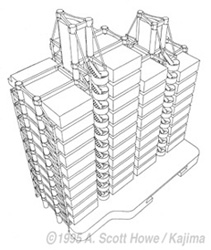
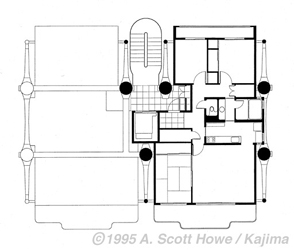
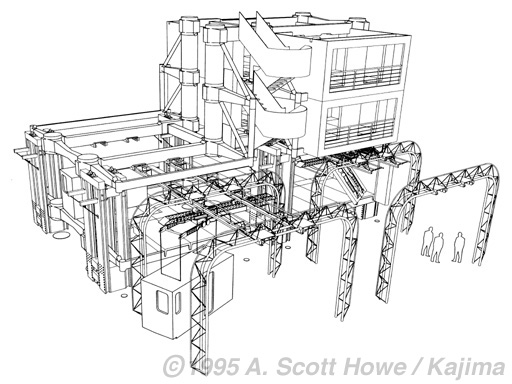
| Z PROJECT: Design studies for automated building system and kit-of-parts. Presented as a design-sensitive alternative to a project already in the design stages. A kit-of-parts concrete panel and suspension structure which can be assembled using automated means. The assembly takes place on the ground level. Upon completion of a floor, the entire building is lifted up by the AMURAD jacks, and work commences on the next lower floor. Conceptual design for the project was completed by A. Scott Howe in Fall 1994. Only design steps were taken for this alternative. However, the Chigusa project was built using Kajima's AMURAD automated lift-up system, which was among the world's first automated holistic construction hardware systems.
Technical papers and articles:
A.S. Howe (2003). Design Principles for Kinematic Architecture. Proceedings of the Second International Conference on Construction in the 21st Century (CITC-II). 10-12 December, 2003, Hong Kong.
A.S. Howe; I. Ishii; T. Yoshida (1999). Kit-of-parts: A review of object-oriented construction techniques. Proceedings of the International Symposium on Automation and Robotics in Construction (ISARC16). 22-24 September 1999, Madrid, Spain. London: International Association for Automation and Robotics in Construction (IAARC).
Miyamoto, Ishii, Shibata, Dobashi, Howe, Yoshida, Takada, Ueno, Kunugi, Yagi, Nakata, Hatakeyama, Kigawada, Yomo, and Koga (1998). Study on assembly process for large-scale structures. Heisei 10 nendo IMS Kenkyu Seika Koen Ronbushu (1998 IMS Research Results), pp.119-122. Tokyo, Japan: Intelligent Manufacturing Systems (IMS) Center.
|
|
|
| . |
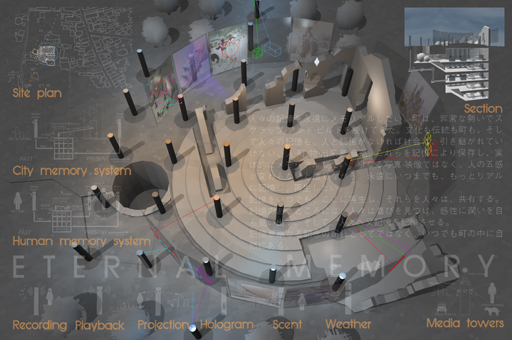
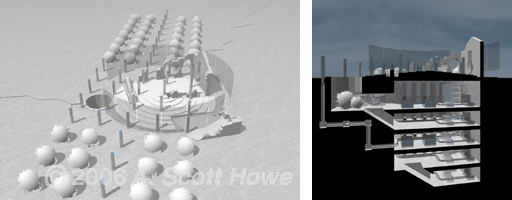
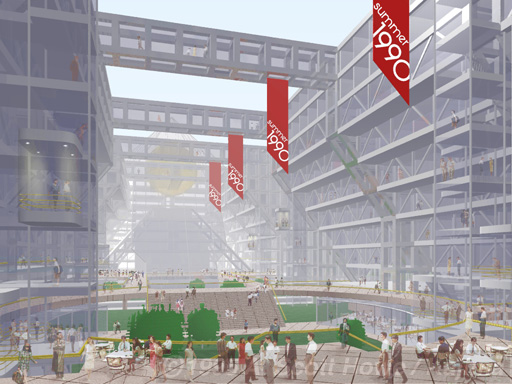
| MEMORIAL HALL: An exterior memorial space dedicated to the inhabitants of a city. Established at a ruin site within the city, the memorial becomes an amphitheater where the entire town is the stage, visible through clear screens containing liquid crystal cores. Visitors can relax on the tiered circular seating with their backs to the center and observe the actual town or images of the past overlayed on the present. "Media towers" layed out in a grid pattern on the site and extending into the town have multiple functions of recording & playback of sound and images, image projection, hologram projection, weather data recording, etcetera. The recorded data goes into a data bank located underground. Visitors would be recorded themselves as they observed past recordings of themselves and the city. In the future, they may return again and again to view their past selves and the changing atmosphere of the town.
Design and presentation were completed by A. Scott Howe and Yuji Kaido. Graphics by Chizuko Sami. Only conceptual design steps were taken in Fall 1993. Materials submitted to Nisshin Kogyo's Memorial Hall Architectural Design Competition.
|
|
|
| . |
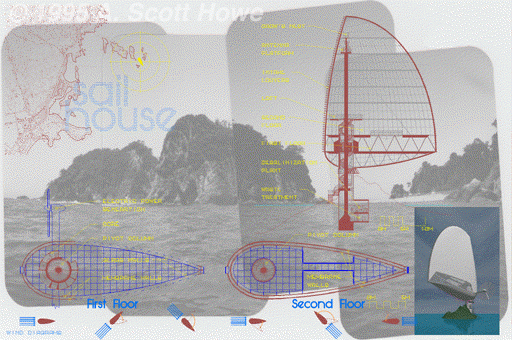
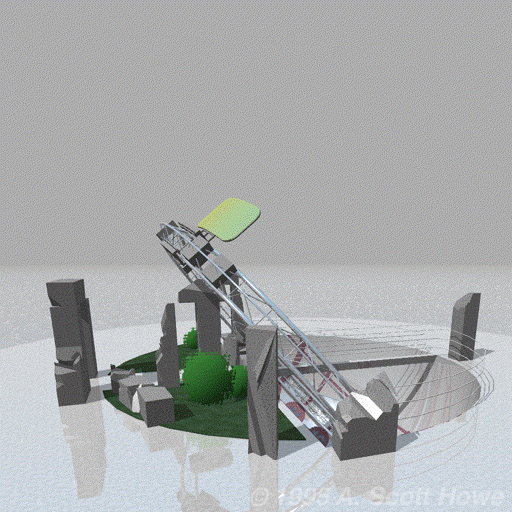
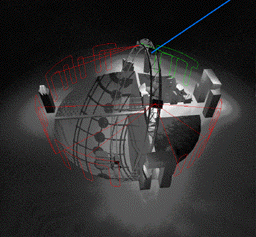
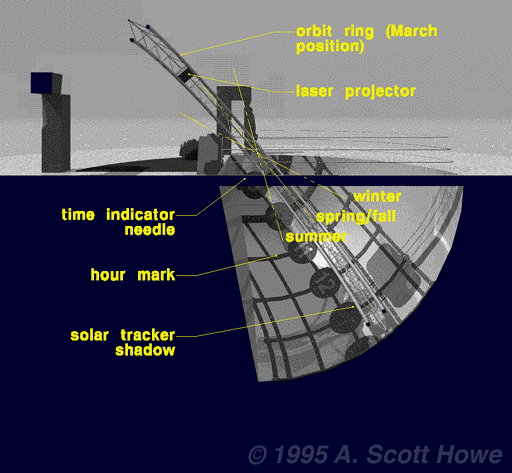
| SAIL HOUSE: Approximately 255m2 (2,740sf) summer residence. Supported by a single pivot column built on a small island or rock. Entire residence is shaped like a sail and freely rotates on the pivot column. All core elements are fixed to the column and do not rotate. When wind direction changes, orientation of the sail superstructure changes with it. Sail walls consist of two layers of membrane with air intake louvers on the upwind end and air outlet louvers on downwind end. During summer months louvers open and allow for natural ventilation, warm air accumulated in the high parts of the interior space drawn outside. During cold periods louvers close to allow heat to accumulate between the double walls. Ventilation stacks circulate air within the high space. An array of solar panels located on the neck of the pivot column tracks the sun at all times of the day during all seasons. Two propeller-type windmills generate electricity. Below grade / water level a small desalinization plant provides fresh water from the ocean and waste treatment equipment processes all sewage. In addition to the two levels used for the mechanical equipment, occupied space includes first floor, second floor, loft and crow's nest, with a small communications platform for antennas and equipment.
Design and presentation by A. Scott Howe, completed in summer 1993. Only conceptual design steps were taken.
|
|
|
| . |
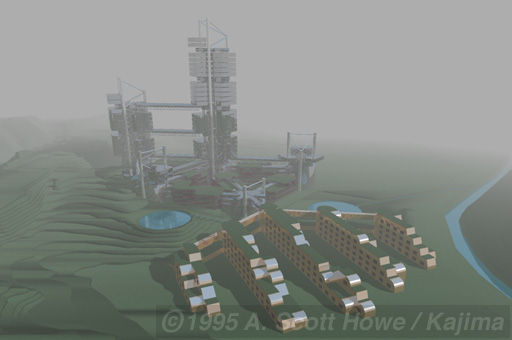
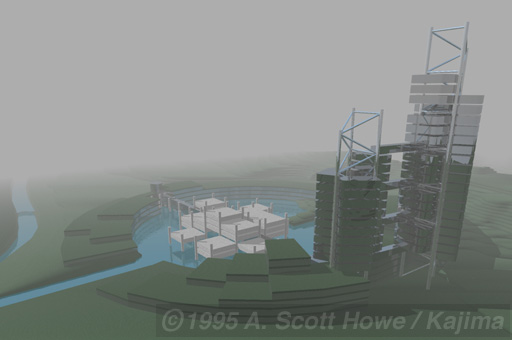
| HITACHI HEADQUARTERS II: Approximately 87,000m2 (940,000sf) headquarter office / subsidiary office / commercial / residential facility master plan for redevelopment of the Hitachi Totsuka factory site in Totsuka-ku, Yokohama, Japan, for the Hitachi Manufacturing Corporation. Two semicircles of buildings are back to back in order to allow for actual or perceived future expansion. To the north, lowrise subsidiary company offices stretch like fingers into the surrounding neighberhood. To the south, a series of nodes link lowrise buildings, each node having the potential of becoming the base for a highrise tower. The node system can be expanded to the south. The towers lie on the southernmost point to protect the daylighting rights of the surrounding neighborhoods and are linked to each other by suspended sky bridges at several levels.
Design team includes project architect Toyohiko Arakawa, and conceptual design by A. Scott Howe. Other design team members include Masanori Gyotoku and Hidenori Okamoto. Estimated Fall 1992 construction costs were 60.9 billion yen (approx. US$487.2 million). Only conceptual design steps were taken for this project.
|
|
|
| . |
| DENVER URBAN FOLLIES: A series of follies to be located on the Sixteenth Street pedestrian mall designed by I. M. Pei for the City of Denver. Various stages of life are represented by four follies placed in a line, using the life of a river as a vehicle of symbolism. Conception of a river occurs when the sun evaporates the ocean and forms clouds. The river is born from the atmosphere when the clouds rain. The river goes from infancy to old age through various mountains and valleys of life's obstacles. A river experiences death when it reaches the ocean where the cycle starts all over again. Each folly receives a laser beam from the preceding structure, representing a river of light, and a laser image of the first folly is projected into the interior of the last to complete the cycle.
Design team included four designers: A. Scott Howe, Atsuko Kimata, Jeffrey E. Brantner, Shinichiro Kosho (design of folly shown here is by A. Scott Howe). The follies were designed for an idea competition in Fall 1991.
|
|
|
| . |
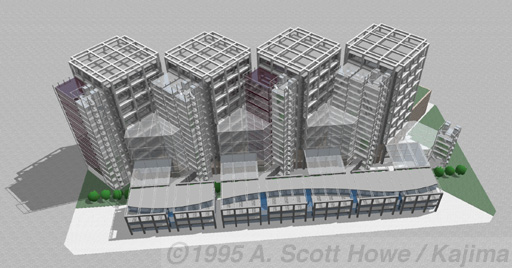
| SONY TECHNOLOGY CENTER: 111,000m2 (1,194,900sf) office / research / showroom complex to be located in the Makuhari region of Tokyo Bay, Japan for Sony Corporation. Four towers set at a fourty-five degree angles are in line parallel to a green mall and showroom facilities. Exoskeleton structure and exposed trusses characterize major parts of the project.
Design team included project architect Kunihide Oshinomi, senior architect Yukishige Miyamae, project manager Maki Ishii, and designers Norio Kita, Hiroyuki Sakamoto, A. Scott Howe, and Yasuto Ota. Structural design was by Hideo Hayashi. Mechanical design by Hideo Tanaka. The project cost for summer 1991 was estimated at 51.9 billion yen (US$415.2 million).
|
|
|
| . |
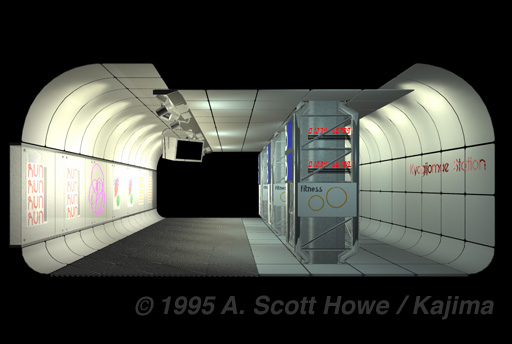
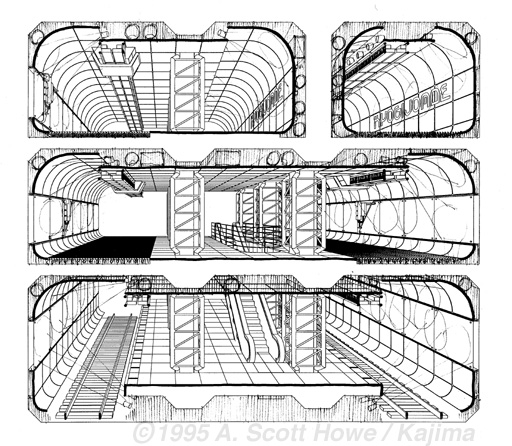
| TOKYO OEDO LINE SUBWAY STATION: Conceptual systems for two 7,000m2 (75,300sf) new stations out of a total of thirty eight (As required in the competition, Kokuritsu Kyogijomae and Tsukijima stations) to be located on the new Oedo Line in Tokyo, Japan for Toei Metrorail Corporation, Japan. In this design Kokuritsu Kyogijomae station is clad in a sleek, high-tech skin system with information panels and plug-in media strips. A downtown "Edo Shitamachi" small shop / narrow street atmosphere characterizes the Tsukijima station.
The project manager was Izumi Doihara, with designers A. Scott Howe and Katsuhiro Fujita. The estimated Fall 1990 cost was 1.4 billion yen (approx. US$11.2 million). Commission was awarded for the design and construction of Ryokoku and Kuramae stations on the Oedo Line.
|
|
|
| . |
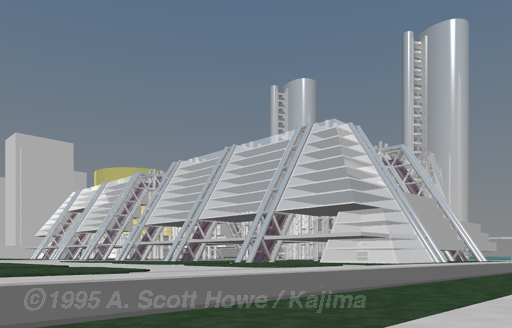
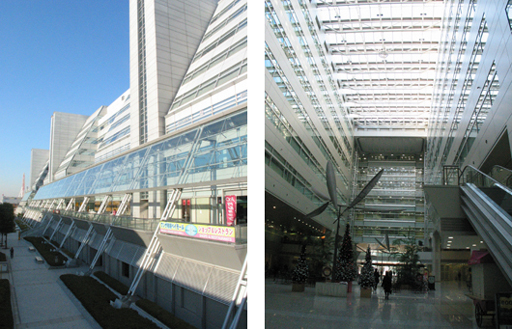
| TOKYO FASHION TOWN: 197,000m2 (2,124,000sf) office / studio / showroom complex (including residential units) to be located in the Ariake region of Tokyo Harbor, Japan for Tokyo Fashion Kyokai, Japan. A skeletal supertruss system supports spaces suspended between them in a sloped cantilever. Two cantilevers oriented in opposition to each other form a large exterior public event space. The cantilever is turned in on itself in a U-turn at one end, and residential towers terminate the other end.
Design team included project architect Tomohisa Yuri, senior architect Toshiyuki Watanabe, project manager Izumi Doihara, with conceptual design by A. Scott Howe. Residential design was by Mikio Kobayashi and Osamu Ueoka. Structural design was by Shigeru Ban and Yoshiki Mihara. Mechanical design was by Hiroshi Sase, Minoru Tsujimoto, and Akira Ebisawa. JV partner Kenzo Tange office. The project was estimated at 112.9 billion yen (approx. US$903.2 million), for the Fall of 1990. The project was not completed at that time, but was passed to another company, who eventually constructed a toned down version based on our design (see photos).
|
|
|
| . |
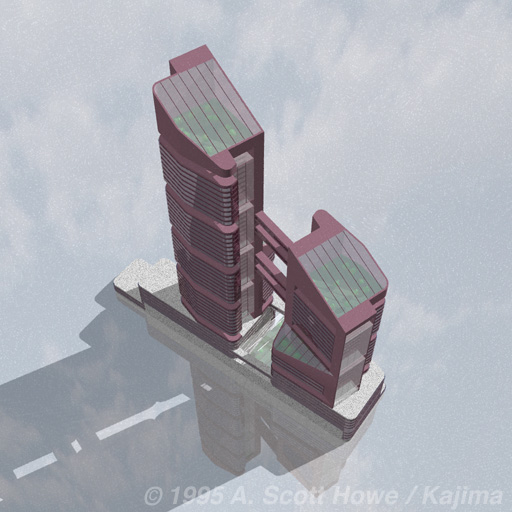
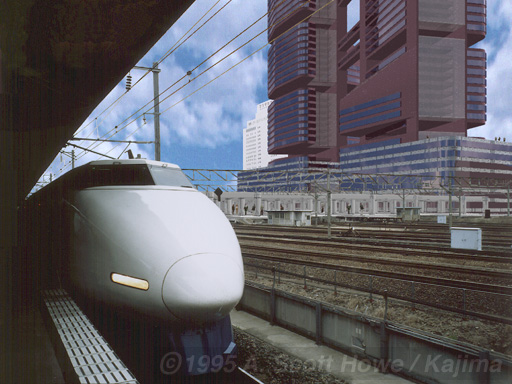
| JR TOKAI CORPORATE HEADQUARTERS: 174,000m2 (1,880,000sf) highrise corporate headquarters office building to be located in Nagoya, Japan for JR Tokai, formerly a part of Japan National Railway. Twin towers oriented true north-south are capped off with park-like atriums. Curtainwall systems vary from facade to facade depending on orientation and solar exposure. Exterior roof decks occur every ten floors.
All design completed by project architect A. Scott Howe. Construction costs for spring 1990 were estimated at 104.4 billion yen (approx. US$835.2 million). The headquarters were designed as a promotional project in conjunction with a Kajima Civil Engineering Division railway project, only conceptual design steps were taken.
|
|
|
| A Scott Howe, PhD |