Kawasaki Safety Intelligent Plaza / Neolab (1989 / 1991)
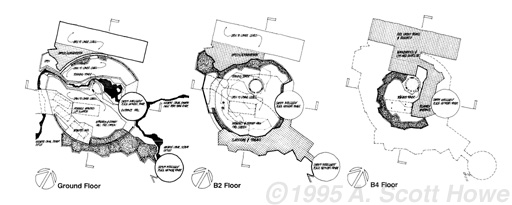
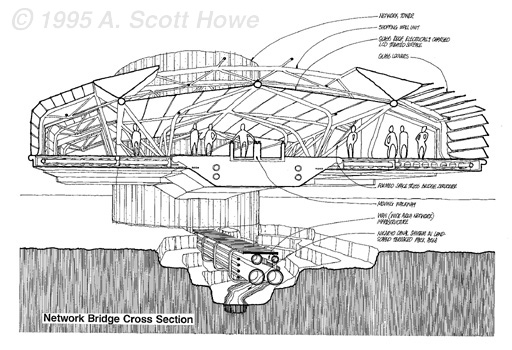
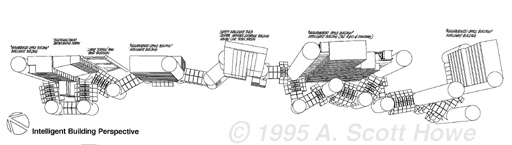
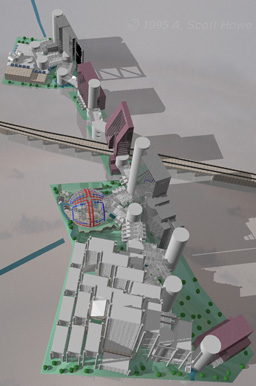
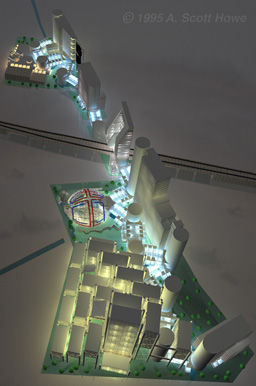
CONCEPT: Infrastructure elements, including informational systems, utilities and mass transit, are brought together into a "structure" which links together eight buildings and sub-complexes. Principles of robotics, automation, "neighborhood office" and advanced informational networking are fully incorporated.
SCHOOL: University of Utah fifth year design Master of Architecture course, on exchange at Kanagawa University, Yokohama, Japan utilizing Kajima Corporation's computer systems, software and computer graphics technology. Funded by University of Utah research grant.
DATE: 1989.
Technical papers and articles:
A.S. Howe; Y. Hirata (1991). A Feasibility Study for a New Architectural Design Approach Using 3D Solid Modeling CAD Systems. The Fourth International Conference on Computing in Civil and Building Engineering: Extended Abstracts, p.39. Tokyo, Japan: Hirakawa Kogyosha Co. Ltd.
A.S. Howe (1989). Kawasaki Safety Intelligent Plaza. (University of Utah M Arch thesis).
NEOLAB CLIENT: A Kajima Corporation research project.
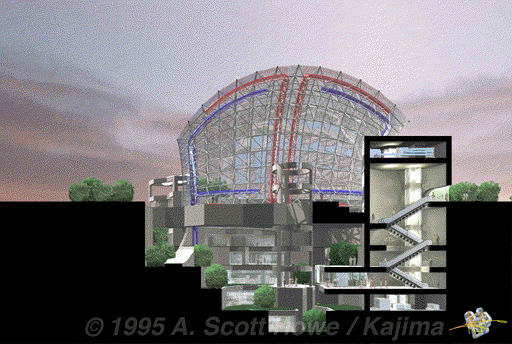
NEOLAB CONCEPT: Various research functions surround a central spherical atrium space, with the lower hemisphere forming a negative cavity below grade and the upper hemisphere having the form of a dome. The crystalline dome reflects the beauty of the surrounding sky, greenery and ocean and incorporates functions which capture solar energy. The atrium serves as a link to the surrounding community with exhibits and demonstrations of current research projects on public display.
NEOLAB DESIGN TEAM: Project architect, conceptual design & structure: A. Scott Howe.
NEOLAB COST: Estimated 25 billion yen.
NEOLAB DATE: Spring 1991.
NEOLAB STATUS: As a model laboratory, only conceptual design steps were taken.