High-Performance Structures
OBJECTIVES: All courses and studios taught by Dr. Howe in regards to extreme architecture rigorously conform with National Architectural Accrediting Board (NAAB) Condition 13 Criterion 4 "Research Skills", Criterion 5 "Formal Ordering Systems", Criterion 17 "Site Conditions", Criterion 18 "Structural Systems", Criterion 19 "Environmental Systems", Criterion 21 "Building Envelope Systems", Criterion 22 "Building Service Systems", Criterion 23 "Building Systems Integration", and Criterion 24 "Building Materials and Assemblies". Dr. Howe also emphasizes a link with Criterion 3 "Graphic Skills", Criterion 6 "Fundamental Design Skills", Criterion 15 "Sustainable Design", and Criterion 16 "Program Preparation".
INPUT / CONSTRAINTS:
- Prove technical feasibility in the pertinent extreme environment.
- Cost considerations are optional, secondary to technical feasibility.
OUTPUT / DELIVERABLES:
- Viable engineered structures appropriate for exreme environment.
- Elegant architectural solutions integrated with engineered systems.
EXAMPLE STUDENT WORK:
In one study, Dr. Howe teamed with Andreas Vogler, Thomas Kvan, and Justyna Karakiewicz to encourage students to design a variety of extreme structures. Xiaoyu Qu (HKU, arch4001/4002 graduate design studio, 2003-04) developed a design for a tensile tower, with a single compressive column in the middle, and tensile net facades. Each of the floor plates in the design were entirely hung from above, suspended away from the central column. The structural concepts for this design were rigorously tested using a variety of sized floor plates laser cut from acrylic sheet, suspended from a threaded rod using tensioned fishing line in a facade mesh (figure 1).
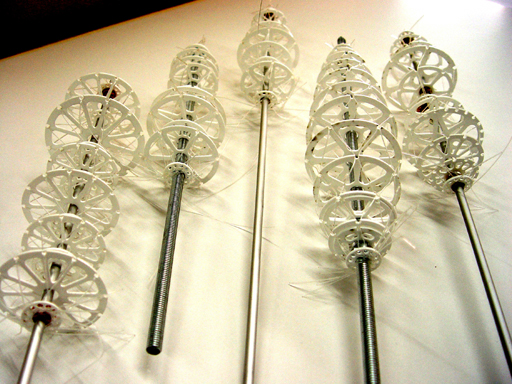
Figure 1: High-performance cantilevered tower structure design by Xiaoyu Qu
Xiaoyu experimented with various shaped floor plates, such as triangular, circular, etc. and variably reduced the size of the plates to taper, pinch, or expand habitable volume (figure 2).
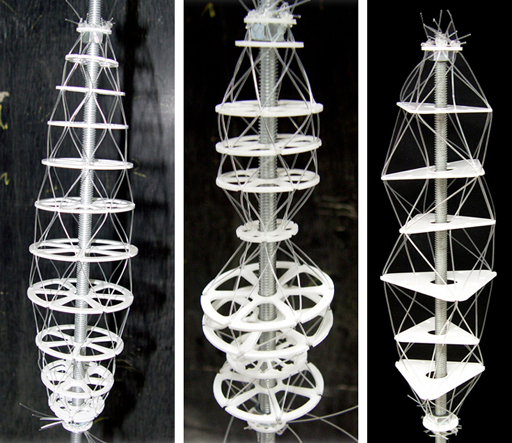
Figure 2: Variation on floor plate shape and size
Xiaoyu also experimented with eccentrically loaded towers, taking the required guy wires into the design (figure 3).
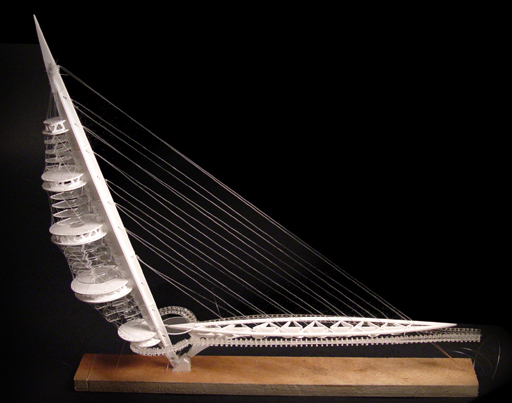
Figure 3: Eccentrically loaded tower