Deployable / Compact Structures
In some studies, the extreme environment is a lack of adequate space. Students are given an impossibly small volume and asked to come up with a solution for a certain program.
OBJECTIVES: All courses and studios taught by Dr. Howe in regards to extreme architecture rigorously conform with National Architectural Accrediting Board (NAAB) Condition 13 Criterion 4 "Research Skills", Criterion 5 "Formal Ordering Systems", Criterion 17 "Site Conditions", Criterion 18 "Structural Systems", Criterion 19 "Environmental Systems", Criterion 21 "Building Envelope Systems", Criterion 22 "Building Service Systems", Criterion 23 "Building Systems Integration", and Criterion 24 "Building Materials and Assemblies". Dr. Howe also emphasizes a link with Criterion 3 "Graphic Skills", Criterion 6 "Fundamental Design Skills", Criterion 15 "Sustainable Design", and Criterion 16 "Program Preparation".
INPUT / CONSTRAINTS:
- Prove technical feasibility in the pertinent extreme environment.
- Cost considerations are optional, secondary to technical feasibility.
OUTPUT / DELIVERABLES:
- Viable engineered structures appropriate for exreme environment.
- Elegant architectural solutions integrated with engineered systems.
- Workable functional solutions for extremely tight spaces.
EXAMPLE STUDENT WORK:
Connie Yuen Nam Luk (HKU, MArch thesis, 2005-06, co-tutors Howe, Chris Bene, and Carol Leung) developed a standard collapsible airtight module for containment of communicable deseases (figure 1). Modules can be transported to an emergency location and assembled into a field hospital that can handle natural disaster relief or disease outbreaks (figure 2). Modules can be stacked two stories tall (figure 3). Connie worked out a collapsible bellows and scissor truss mechanism that can withstand 1psi negative pressure upon deployment (figure 4).
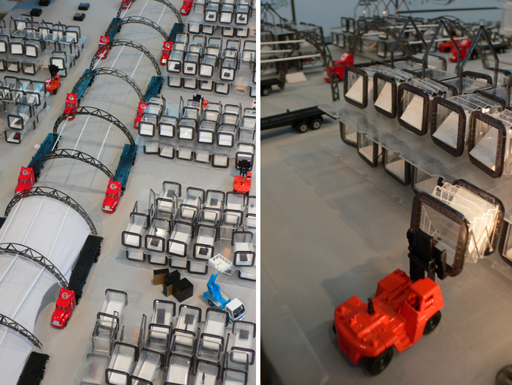
Figure 1: Field hospital by Connie Yuen Nam Luk
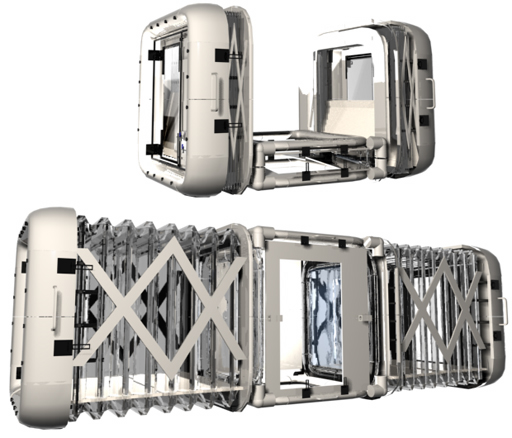
Figure 2: Collapsible modules
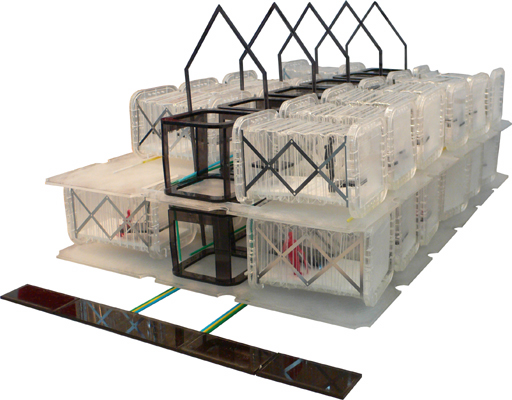
Figure 3: Two storied structure
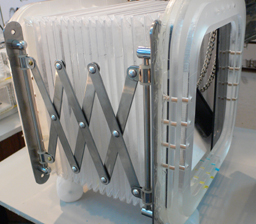
Figure 4: Scissor truss mechanism
Michael Mang Kwan Lin (HKU, arch2013 2nd year design studio, 2004-05) in his second year studio designed a motorcycle shop / research facility resembling sets of cogs (figure 5). The cogs are resting on a set of wheels to cause them to rotate in meshed fashion to rotate displays (figure 6).
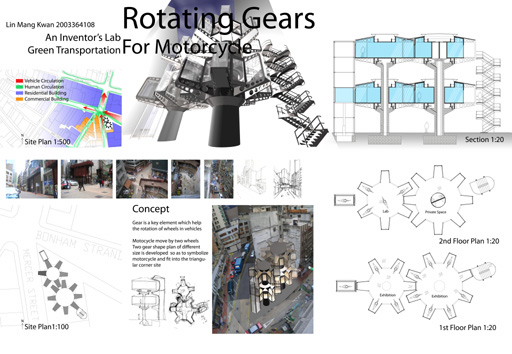
Figure 5: Cog-shaped motorcycle shop by Michael Mang Kwan Lin
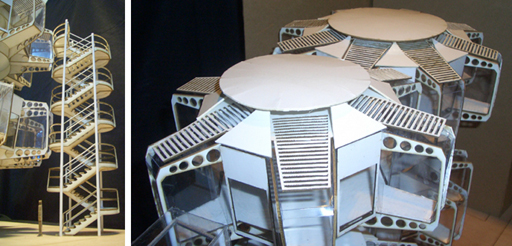
Figure 6: Meshed cogs in system
For compact structures, Dr. Howe often assigns students to design novel ways to think outside the box for normal activities such as passing from one room to another, to encourage them to think about the experience of passing through spaces. One problem that is often used is the "gate" assignment, where a portal or doorway is designed between two spaces. Kynson Chang (HKU, arch2013 2nd year design studio, 2003-04, co-tutors Dr. Howe and Dr. Alex Amato) designed an interesting filter-like mechanism that allows only one person through to an inside space, and no others can enter until that person exits again (figure 7).
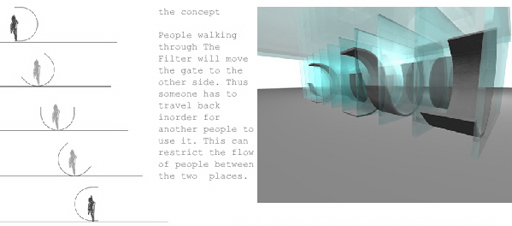
Figure 7: Filter gate by Kynson Chang
Another technique used by Dr. Howe is to assign a program to an impossibly small volume, and require the students to come up with a solution. These problems are often not critically assessed according to egress or a safety standpoint, but are used to help the student consider double and triple use of spaces in deployable and compact structures.
One problem that is often used is the 1m wide alley project. Students are given a 1m wide gap between buildings 10m deep and 10m high, and are required to insert homeless shelters, or some such simple program. Since the alley is only 1m wide, students cannot use the space to pass circulation to the side of used space, but must go vertically in novel ways to fit in the program. Zohar Schwartz (UofO, arch484/584 vertical studio, 1998-99) developed an inverted pyramid that has deployable bridges and "stair doors" to access sleeping compartments (figure 8).
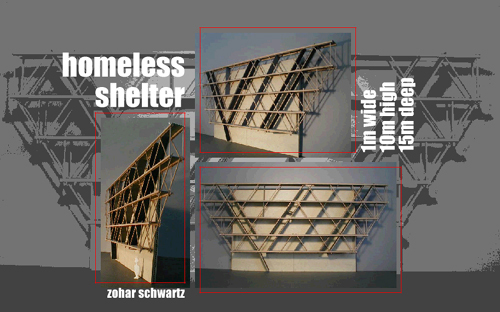
Figure 8: Homeless shelter by Zohar Schwartz
Another problem requires students to design a fully working bathroom in a 1m square space. Dominic Kin Tak Mak (HKU, arch2013 2nd year design studio, 2003-04, co-tutors Dr. Howe and Dr. Amato) created a mobile deployable closet-type bathroom with openable shower, toilet, and wash basin (figure 9). Another version of the compact bathroom was developed by Gee Ki So (HKU, arch2013 2nd year design studio, 2003-04), who put all the functions into a thick upstanding slab, that folds out when needed (figure 10).
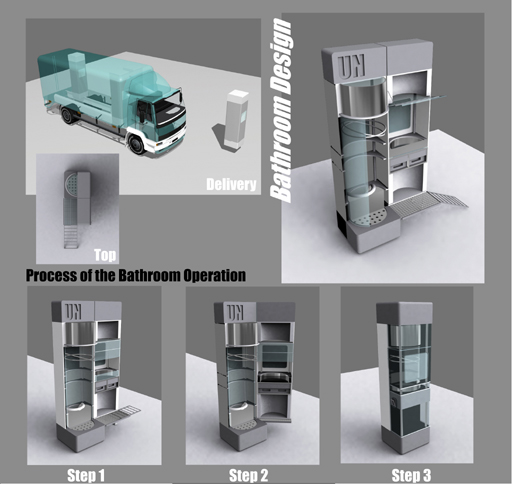
Figure 9: Compact bathroom by Dominic Kin Tak Mak
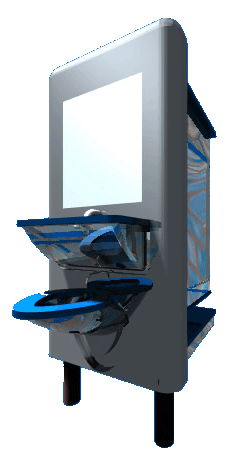
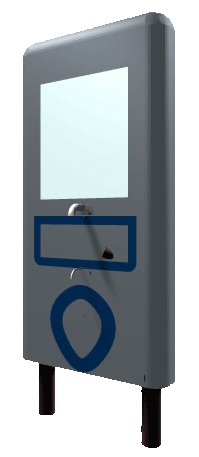
Figure 10: Compact bathroom by Gee Ki So