High-altitude Structures
OBJECTIVES: All courses and studios taught by Dr. Howe in regards to extreme architecture rigorously conform with National Architectural Accrediting Board (NAAB) Condition 13 Criterion 4 "Research Skills", Criterion 5 "Formal Ordering Systems", Criterion 17 "Site Conditions", Criterion 18 "Structural Systems", Criterion 19 "Environmental Systems", Criterion 21 "Building Envelope Systems", Criterion 22 "Building Service Systems", Criterion 23 "Building Systems Integration", and Criterion 24 "Building Materials and Assemblies". Dr. Howe also emphasizes a link with Criterion 3 "Graphic Skills", Criterion 6 "Fundamental Design Skills", Criterion 15 "Sustainable Design", and Criterion 16 "Program Preparation".
INPUT / CONSTRAINTS:
- Prove technical feasibility in the pertinent extreme environment.
- Cost considerations are optional, secondary to technical feasibility.
OUTPUT / DELIVERABLES:
- Viable engineered structures appropriate for exreme environment.
- Elegant architectural solutions integrated with engineered systems.
EXAMPLE STUDENT WORK:
Simon Sai Man Mok (HKU, MArch thesis, 2005-06, co-tutors Howe, Chris Bene, and Carol Leung) found off-the-shelf technology in the form of Sky Cat, an airship that can lift containers for loading and unloading container ships in cargo terminals (figure 1). Using the international shipping container standard, Simon devised a modular sky hotel for eco-tourism (figure 2), made of ultralight composite building materials. The sky hotel has several modes, depending on the modules being carried at the time: daytime restaurant, overnight, and cruising, etc. The sky hotel is equipped with a crane that rides a U-shaped rail (one rail down starboard, turning the base of the U at stern to make another rail along the port side) in order to load and unload modules. The overall presentation panel can be seen in figure 3.
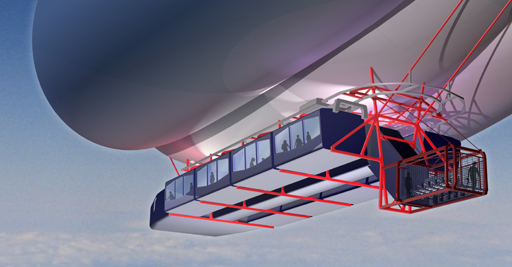
Figure 1: Sky hotel by Simon Sai Man Mok
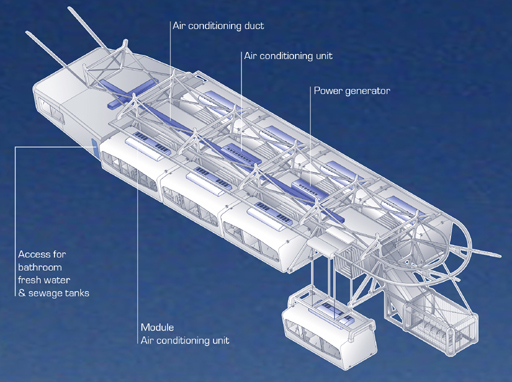
Figure 2: Modular gondola structure
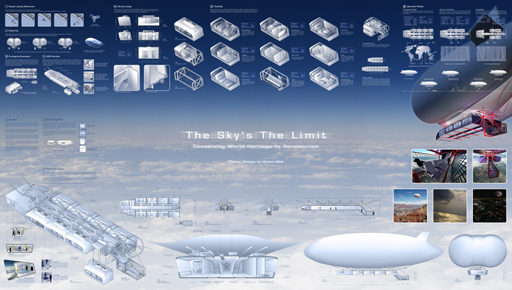
Figure 3: Simon's overall panel