Changes in Architectural Depiction

OBJECTIVES: Courses taught by Dr. Howe under the digital media and process theme rigorously conform with National Architectural Accrediting Board (NAAB) Condition 13 Criterion 3 "Graphic Skills", which states that courses should instill an ability to select and use appropriate digital representations, making distinctions such as 2-D graphics versus 3-D surface models versus 3-D solid models, vector-based versus pixel-based graphics, output devices and image resolution, and trade-offs between data size, compression, and image quality. In addition, Dr. Howe emphasizes a link with Criterion 5 "Formal Ordering Systems", and Criterion 6 "Fundamental Design Skills".
INPUT / CONSTRAINTS:
- Existing three- and four-dimensional (time-based) spatial hierarchies and experiences.
- New spatial hierarchies designed by the student.
OUTPUT / DELIVERABLES: Digital interpretation of spaces, functions, and structure through:
- Fixed sequences such as video and animation.
- User-navigated models such as VRML.
- Function interpretation overlay using chromakey curtains and student actors to show how a space will be used.
EXAMPLE STUDENT WORK:
Kevin Kin Man Sy created a VRML portfolio (HKU, arch5306 changes in architectural depiction, 2002-03), showing his design work on the wall in a clickable format (figure 1). A VRML plugin is required to view the portfolio.
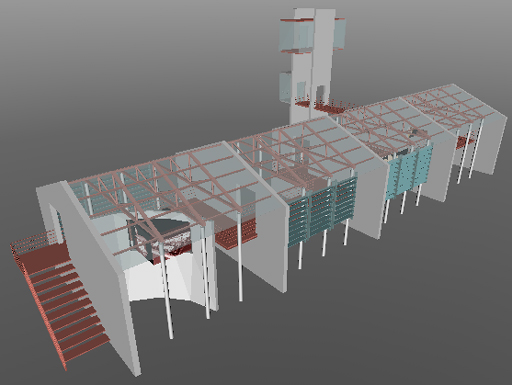
Figure 1: VRML portfolio by Kevin Sy
Jamie Yick created a VRML maze (HKU, arch5306 changes in architectural depiction, 2003-04) as part of her assignment (figure 2).
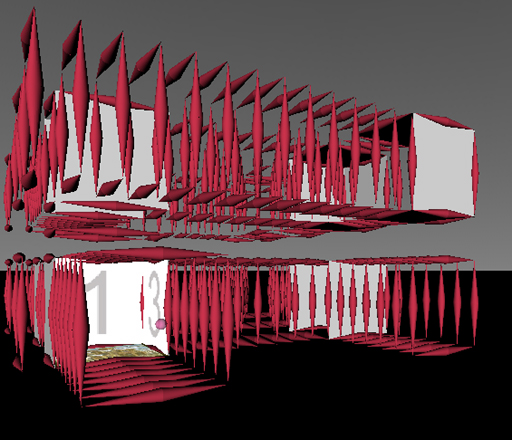
Figure 2: Interactive maze by Jamie Yick
Chi Kwong Tsui (HKU, arch5306 changes in architectural depiction, 2003-04) created a movie (5.9mb) with fellow students acting out activities performed in his display system design, depicting architectural space as a dynamic time-based element.
Wilson Chun Yu Wong (HKU, arch5306 changes in architectural depiction, 2003-04) created an animation (21.6mb) using a combination of traditional frame-by-frame character animation, digital computer animation, and video to produce a short story about an adventure taking place in an urban space.