Digital Design
One rigorous method for teaching students an objective approach to design and manipulating fundamental architectural elements (wall, column, etc) has been carefully fostered over the years, in partnership with Nancy Cheng and later Marcaurel Schnabel. The method begins with a pre-defined generic, nondescript kit-of-parts corresponding directly with eight fundamental architectural elements: column, beam, wall, corner, floor, truss, roof, stairs. The basic elements can be thought of as plain-text font, that can be selected later and replaced with a variety of different "flavors" or "font styles" to give the structure a classic, timber, high-tech, etc appearance. Figure 1 shows two libraries with the generic non-descript parts on the left, and a "gothic" style on the right.
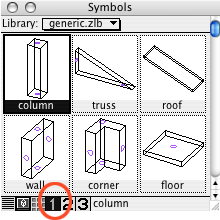
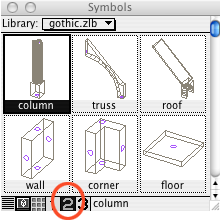
Figure 1: Fundamental architectural elements: left: generic, right: "gothic"
Students can place the generic elements in the workspace to build a structure (figure 2), then quickly replace the pieces (or change the "font") to other "styles" (figure 3 - 7).
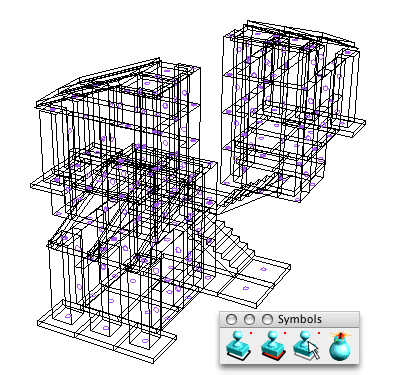
Figure 2: Structure made of plain elements
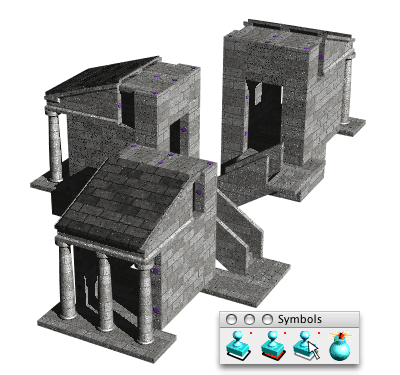
Figure 3: Same elements replaced with "classic font"
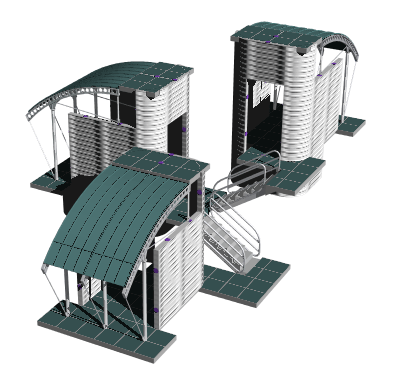
Figure 4: Same elements using "high-tech font"

Figure 5: "space font"
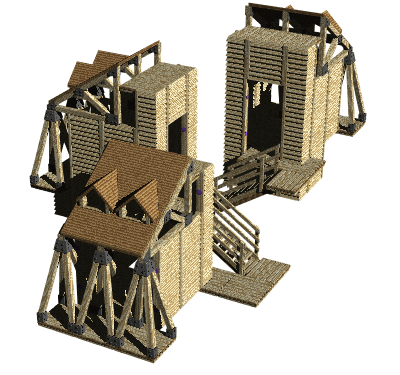
Figure 6: "timber font"
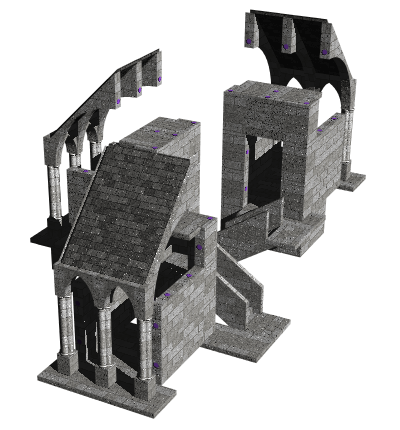
Figure 7: "gothic font"
Note that in this exercise for beginner students, the accuracy of the detail, soundness of the structure, and viability of the enclosure is not the main point, but the association the students get between the elements in the various "fonts" and the skills for manipulating these in an architectural way. In the next step, students design and model their own "fonts" that will fit into the same systems, which are placed online in a clickable html parts matrix that other students can browse. Students are then required to download other student's elements to mix and match resulting in various interesting structures. Once these basic skills have been attained, the students are encouraged to move outside the strict confines of the original eight element system. Students are required to build and maintain a webpage, where all assignments and projects are posted. Assignments are viewed and graded remotely via a clickable html assignment matrix.
OBJECTIVES: Courses taught by Dr. Howe under the digital media and process theme rigorously conform with National Architectural Accrediting Board (NAAB) Condition 13 Criterion 3 "Graphic Skills", which states that courses should instill an ability to select and use appropriate digital representations, making distinctions such as 2-D graphics versus 3-D surface models versus 3-D solid models, vector-based versus pixel-based graphics, output devices and image resolution, and trade-offs between data size, compression, and image quality. In addition, Dr. Howe emphasizes a link with Criterion 5 "Formal Ordering Systems", and Criterion 6 "Fundamental Design Skills".
INPUT / CONSTRAINTS:
- Design and depiction requirements.
- All content must be produced digitally, or converted from traditional media.
OUTPUT / DELIVERABLES:
- Computer models, digital presentations, PDF files, printed panels, rapid prototyped models, laser-cut models, animations, etc.
- All work in entirely digital format.
EXAMPLE STUDENT WORK:
Using the given kit-of-parts, most of the following structures can be assembled and rendered in less than five minutes:
Jon Zegers (UofO, arch222/610 computer graphics introduction, 1999-00) used the given kit-of-parts pieces in novel ways, tipping them sideways to produce an interesting structure (figure 8 and figure 9).
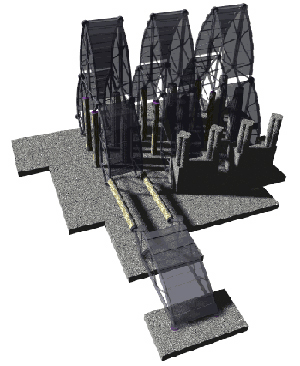
Figure 8: Kit-of-parts structure by Jon Zegers
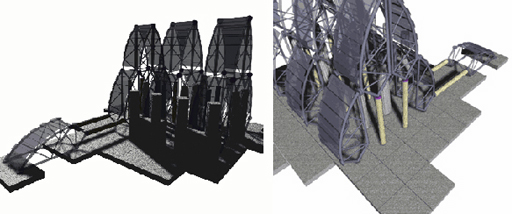
Figure 9: Kit-of-parts structure by Jon Zegers
Eugene Chung (UofO, arch222/610 computer graphics introduction, 1999-00) used the give kit-of-parts system to produce viable (figure 10) and imaginary structures (figure 11).
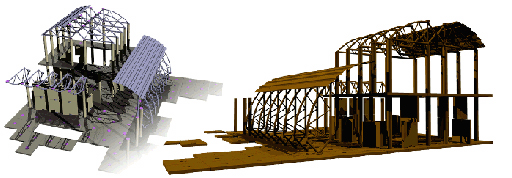
Figure 10: Structure by Eugene Chung
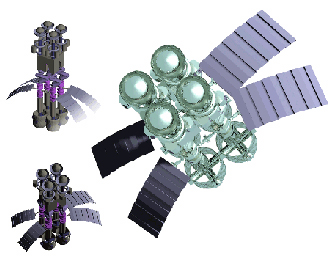
Figure 11: Imaginary spacecraft by Eugene Chung
Samantha Wing Sum Liu (HKU, arch1008 visual communications, 2002-03) places an interesting structure derived from the given kit-of-parts into a field of flowers (figure 12).

Figure 12: Kit-of-parts structure by Samantha Wing Sum Liu
Gee Ki So (HKU, arch1008 visual communications, 2002-03) creates a tiered structure using the given kit-of-parts (figure 13).
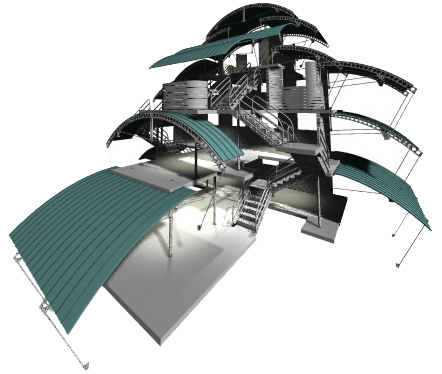
Figure 13: Kit-of-parts structure by Gee Ki So
After students use the given kit-of-parts, they are asked to create their own parts following the same constraints, so pieces will be interchangeable. New parts designed by Kuan Huang (HKU, arch1008 visual communications, 2003-04) and Yuet Mei Cheung (HKU, arch1008 visual communications, 2003-04) are shown in figure 14.
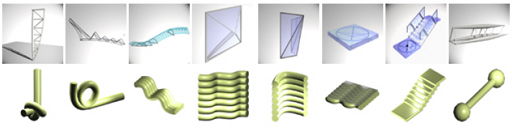
Figure 14: New sets of parts by Kuan Huang (top) and Yuet Mei Cheung (bottom)
In previous work, Dr. Howe has evolved the kit-of-parts approach using non-architectural "widgets". Christopher Houston (UofO, arch222/610 computer graphics introduction, 1999-00) designed a whimsical structure using his own widget design (figure 15).
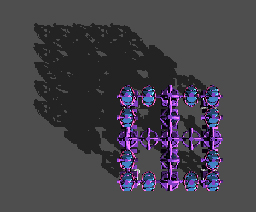
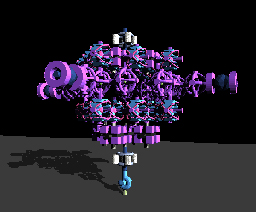
Figure 15: Whimisical structure by Christopher Houston
Students are then encouraged to work out their own design languages. Piyapong Kanluen (UofM, art455 advanced computer modeling, 1995-06) produced a free-form concert hall design (figure 16).
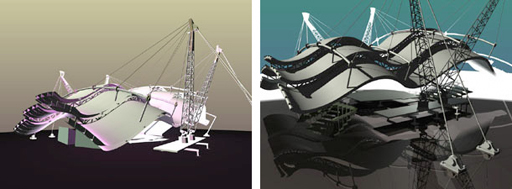
Figure 16: Concert hall by Piyapong Kanluen
Dr. Howe has also supported digital design for industrial designers, supporting their design studios. Cary Cronin (UofM, art455 advanced computer modeling, 1995-06) produced a motorcycle design using skills learned from Dr. Howe's digital design courses (figure 17).
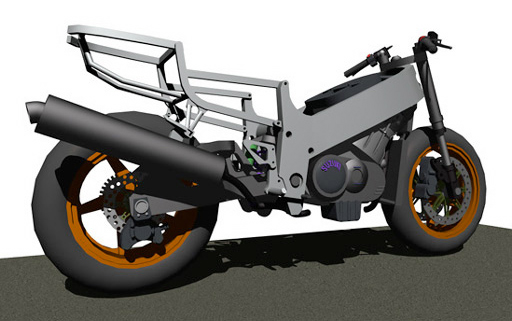
Figure 17: Motorcycle by Cary Cronin
Bill Webb (UofM, art455 advanced computer modeling, 1995-06) designed a portable office system for on-the-move professionals (figure 18 and figure 19).
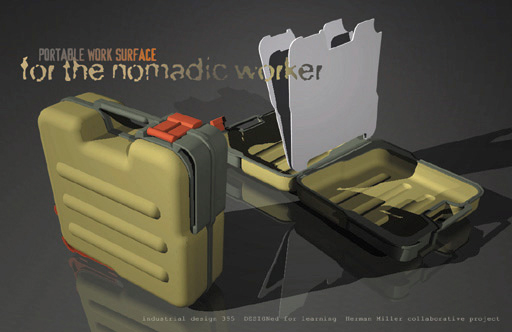
Figure 18: Portable office by Bill Webb
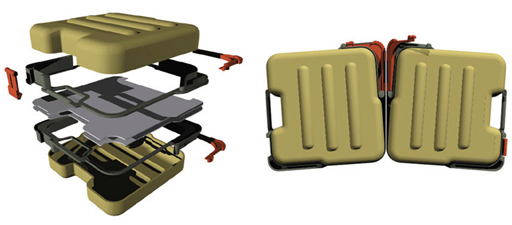
Figure 19: Portable office by Bill Webb